

Half-Life 2: Survivor

|
This article is non-canon. |  |
|---|---|---|
The subject matter of this article does not take place in the "real" Half-Life and Portal universe and is considered non-canon. |

|
Warning! This article has yet to be cleaned up to a higher standard of quality, per our Cleanup Project. It may contain factual errors and nonsense, as well as spelling, grammar and structure issues, or simply structure problems. Reader's discretion is advised until fixing is done. | |
|---|---|---|
You can help clean up this page by correcting spelling and grammar, removing factual errors and rewriting sections to ensure they are clear and concise, and moving some elements when appropriate. |

| |
| Half-Life 2: Survivor | |
|---|---|
| Developer(s) | |
| Release date(s) |
June 28, 2006 |
| Genre(s) | |
| Mode(s) |
Single player, Multiplayer (not available) |
| Platform(s) |
Taito Type X+ arcade machine |
| Input |
2 joysticks (move, shoot), 2 pedals (jump, crouch) |
| Engine | |
| Series | |
Half-Life 2: Survivor is an arcade game based on Half-Life 2. It was released on June 28, 2006 on Taito's Type X+ arcade system, with a 32" widescreen high definition LCD running at 1360x768 resolution. The network service was shut down on February 1, 2010 resulting in multiplayer modes being not available.
A fan-ported PC version was released in June 2013.[1]
Contents
Overview[edit]


Players control the game using two joysticks (one for each hand) and floor pedals. The left joystick is used to control player's movement, pulling it back twice in a quick succession allows to make a 180 degree turn. A button accessible by the thumb is only used in the Battle mode for opening the radio command menu. Movement of the right joystick allows the player to look around and aim, trigger button performs the primary attack, while the secondary attack is performed by a button on the back of the joystick. A wheel similar that of a typical computer mouse is also present, and is used for switching weapons. Crouching and jumping is done with the left and right foot pedals respectively.
Because of the simplified control scheme, such features of the original game as the flashlight, suit zoom and manual reloading are not available. Lack of a dedicated use key also means that the player cannot pick up random objects by hand, however all the necessary interactions are either performed automatically by walking up to the object, or require shooting at it.
Half-Life 2: Survivor is running on two types of arcade machines.[2] The first one, also known as the deluxe version, has a bigger housing with a seat, and was described by several reviewers as looking similar to a racing game cabinet without a steering wheel.[3] The smaller space-saving version is also available, featuring the upright form-factor. Besides the size and the chair, the main difference between both arcade machines is the sound system: while in the deluxe version speakers are placed both on the front panel and behind the player's head, allowing for 5.1-channel surround sound, the space saving version only has two front panel speakers.
An early version of the space-saving arcade machine also exists and is much more rare to encounter. Its screen assembly appears to be reused from the deluxe version, while the game controls are located much farther away from the screen to make space for the arcade hardware located underneath. The machine incorporates a subwoofer along with front-facing stereo speakers. Unlike in other machines, the left joystick shares the same design as the right one.[4]
| Arcade machine comparision | |||
| Deluxe version[2][5] | Space-saving version (early)[4] | Space-saving version[2][5] | |
|---|---|---|---|
| Display | 32-inch LCD 1360x768 |
32-inch LCD 1360x768 |
32-inch LCD 1360x768 |
| Sound | 5.1-channel surround sound system | Stereo speakers with subwoofer | Stereo speakers |
| Size | 890mm wide 1840mm deep 1894mm high |
876mm wide 1118mm deep 2019mm high |
798mm wide 798mm deep 1560mm high |
| Weight | ~180 kg | Unknown | ~130 kg |
| Power consumption | 480 W | 650 W | 320 W |
Gameplay[edit]

Story Mode[edit]
The Story Mode offers a single-player campaign that approximates the original game's storyline. In order to make it more suitable for playing on an arcade machine, substantial parts of the game were removed with just the combat sections left behind. Some of the main plot elements are outlined in skippable cut-scenes.
Battle Mode[edit]
The main Survivor's game mode, featuring most of the custom content and the only mode to receive content updates after the game's initial release, the Battle mode is essentially four-on-four team deathmatch. The players can choose from five playable characters: Ranger, Soldier, Sniper, Engineer and Medic. Each character can be of either Combine or Resistance faction with different stats and available equipment, additional items could also be unlocked by playing.
Mission Mode[edit]
In Mission Mode a team of up to four players fights against various enemies from Half-Life 2 in order to complete a certain objective within given time. A total of three missions are available, their objectives being to collect gems dropped by the killed Antlions, destroy Zombie houses and escape the level while avoiding traps and fighting Combine forces. Each mission is available in three difficulty levels.
Network system[edit]

Like several other Taito's arcade games, Survivor uses the NESYS game network. Special NESYS smart cards were required to save data like the results of the played games for the online ranking, player's name and character.[6] Each card was limited to a single character only, who was chosen during the card registration process and could not be changed later. While it is possible to play without the card, some of the features are inaccessible without it, most notably the accumulation of Battle Points and Survivor Gold. Initially the card was also required to advance past the third chapter of the Story mode and to unlock a difficulty higher than normal in the Mission mode, however these requirements were removed in update 2.07.[7] Each NESYS card was limited to 100 uses, after which a new card would need to be purchased, insertion of a card with no uses into the arcade machine would trigger the process of transferring the saved data onto a new card, during which character's name could also be changed.[8] Cards also had an expiration period: if a card was not used for 90 days, it became unusable and its data could not be recovered.
Survivor camp[edit]
An online service called the Survivor camp was available to all NESYS card owners, accessible by mobile phones and personal computers.[9] Up to 20 NESYS cards could be registered to a single camp. Players could view the results of their previous games and browse the global leaderboards, as well customize their characters:[10]
- Weapons used in the Battle mode could be customized: their order could be changed, unwanted weapons could be unequipped (with some exceptions), new weapons could be purchased with Survivor Gold;
- Default character appearance could be changed with one of the two skins available for purchase with Survivor Gold;
- Player's emblem, a small icon visible in the player list, could be set. Emblems could be acquired by completing certain objectives or purchased with Survivor Gold, by default emblem shows the player's class;
- Messages for the radio communication menu could be chosen.
Expired cards were allowed to be used with the Survivor camp, however if none of the cards were used for 90 days all the camp data was removed with no possibility to restore it.[11]
Development[edit]
Half-Life 2: Survivor was announced on November 1, 2004, 15 days prior to the public release of Half-Life 2.[12] In a self-published press release Taito stated that they are aiming for realistic first-person shooter experience with the help of their new Type X arcade hardware featuring 5.1 digital surround sound and widescreen display. The game was first revealed to the public at Taito's private exhibition in Tokyo on November 29, 2005.[13] It was originally meant to be released in summer of 2005,[12] but was later pushed back to March 2006[13] and then to June 28.
The space-saving version of the arcade machine was showcased at AOU Amusement Expo on February 17, 2007[14] and began operation after March.[2]
Half-Life 2: Survivor version 2.0[edit]
On July 6, 2007 a massive update named Half-Life 2: Survivor version 2.0 was announced.[15] Public testing was held from July 13 to July 26 in 5 Taito-managed stores and 6 third-party stores,[16] on September 15 Survivor 2.0 was showcased again at the 45th Amusement Machine Show.[14] Testers were required to have a special Survivor 2.0 NESYS card, which did not work with the regular Survivor, but could be used after the release of the 2.0 update.[16]
Half Life 2: Survivor version 2.0 started operation on November 29, 2007, adding the following features into the game:[16][17]
- New playable character for the multiplayer game modes – the Medic;
- 21 new weapon for the Battle mode;
- 3 new maps playable in the Battle mode;
- Better support for future online events;
- New battle mode submodes: Tutorial and Single, which allows a single player to match against a team of up to four computer-controlled opponents with adjustable difficulty;
- Survivor Gold – the in-game currency earned by playing any of the game modes, which can be used to purchase certain items in the Survivor Camp;
- Additional customization options in the Survivor Camp: player skins and emblems.
- Redesigned menu interface, in-game HUD and new announcer voice in all game modes.
Several more updates were later added, named 2.01, 2.02, 2.03, 2.04, 2.05, 2.07, and a game balance adjustment update without a version number.[7] In total, these updates added 3 more maps and 11 weapons.
End of the network service[edit]
On October 1, 2009 an announcement was made about the network service termination soon after the launch of the Cyber Diver – Taito's new arcade FPS and a spiritual successor to the Half-Life 2: Survivor.[18] The last random map week began on January 22, 2010,[19] after which since February 1 NESYS cards can no longer be used.
- All Story mode chapters remain playable, but score is not saved and Survivor Gold is not awarded;
- All Mission mode missions can still be played either by a single player or a team of up to four players from the same store. Survivor Gold cannot be earned, therefore custom player skins and emblems are no longer available;
- Only Single and Tutorial submodes of the Battle mode should be available, however National can also sometimes be selected, although no players are present. Players are only able to select either E-Class (beginner) or C-Class (medium), and because of that all weapons that are unlocked by reaching classes higher than C are no longer obtainable, since the Battle Points cannot be accumulated. Items purchasable with Survivor Gold also cannot be obtained.
Half-Life 2: Survivor players were able to obtain special titles for the Cyber Diver.[20] Since the Survivor Camp ID was required, registration remained possible until February 25,[18] after which the Camp was shut down.
The official website was shut down in 2016.[21]
PC port[edit]
On June 18, 2013 the complete Half-life 2: Survivor 2.0 content dump was released,[22] soon after that the game was modified to run on a regular Windows PC. The port gives access to the developer console which was disabled in the original arcade version, therefore making multiplayer possible through the use of console commands.
The game requires the screen resolution to be at least 1360x768, as the position of most of the user interface elements was optimized for the arcade machine's resolution and cannot be changed.
Reception[edit]
The game was met with a generally positive reception. Reviewers found it interesting to play the game in an arcade environment, and considered the shift to an arcade setting an excellent introduction of the Half-Life series to Japan.
Most reviewers agreed that the control scheme, while seeming unusual at first, behaves very intuitively, allowing even people unfamiliar with first-person shooters to play with relative ease.[13][23] Game Watch reporter Kazutaka Toyotomi felt that pressing the floor pedals to crouch and jump "makes [him] feel like 'doing something' rather than just pressing a key". He also praised the developers for paying maximum attention to reducing the possibility of the motion sickness.[13] 4Gamer concluded that the arcade machine might be an interesting opportunity to enjoy the game without having to invest in a new computer or sound system, and encouraged the owners of powerful computers to also try out the experience of Half-Life 2: Survivor.[23]
Trivia[edit]
- Some of the content originally cut from Half-Life 2 has been reused, most notably the Sniper Rifle is based on the cut weapon, the female Combine Sniper's model is based on the cut Combine Assassin and the Combine Engineer textures are based on an early pre-release variant of the Combine Soldier with yellow armpits.
- Two working units were delivered to the Valve's offices and installed in the lobby.[24] They are using an early version of the space-saving housing.
- The game contains a model of Gordon Freeman which seems to be based upon the model used to create official promotional images. The model itself is not used anywhere in the game, but can be briefly noticed in some of the pre-recorded Story Mode cinematics.
Gallery[edit]
Arcade machines[edit]
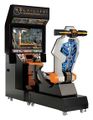
The arcade machine, deluxe version.
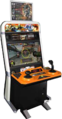
Ditto, space-saving version.
Showcase in August 2006.
Players in August 2006.
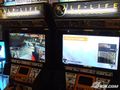
Ditto.
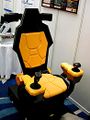
Arcade machine chair.
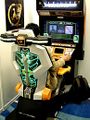
Playing.
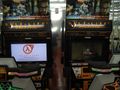
Arcade machine, idle, in July 2006.
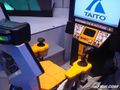
Ditto, in August 2006.
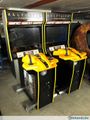
Early version of the space-saving arcade machines.
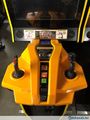
Ditto, showing the temporarily changed joystick design.
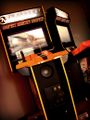
Valve's arcade machines.
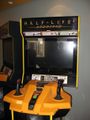
Ditto, in the lobby in July 2008.


Screenshots[edit]
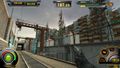
Railway along the Canals.
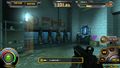
Metrocop and Manhack dispenser in the Canals.
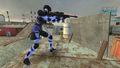
Custom player model in the Canals, with the cut Sniper Rifle.
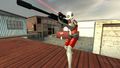
Custom Combine Assassin player model in the Canals, with the cut Sniper Rifle.
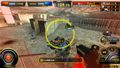
Custom player models in the Canals.
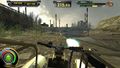
The Airboat firing at Metrocops in the Canals.
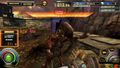
Gravity Gun and Zombies in Ravenholm.
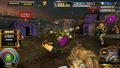
Ditto, with another custom Combine Assassin player model.
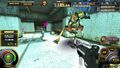
Custom player model and Antlion Guard in Nova Prospekt.
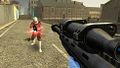
The Sniper Rifle.


References[edit]
- ↑ Half-Life & Portal series, general discussion (v5) on Facepunch (archived)
- ↑ 2.0 2.1 2.2 2.3 Differences from PC version on the official Survivor website (prior to the 2.0 update) (archived)
- ↑ Half-Life 2 to hit Japanese arcades on GameSpot (archived)
- ↑ 4.0 4.1 Taito's Half-Life 2: Survivor arcade machines - for sale on 2dehands.be (archived)
- ↑ 5.0 5.1 Half-Life 2: Survivor 2.0 on Amusement Journal
- ↑ Q&A about the NESYS card on the official Survivor website (archived)
- ↑ 7.0 7.1 Version history on the official Survivor website (archived)
- ↑ Playing with cards on the official Survivor website (archived)
- ↑ Q&A about the Survivor camp on the official Survivor website (archived)
- ↑ Q&A about card customization on the official Survivor website (archived)
- ↑ How to use the camp? on the official Survivor website (archived)
- ↑ 12.0 12.1 The newest popular PC game, grabbing attention of the entire world, can be enjoyed at amusement facilities! Teaming up with Valve Corporation on arcade Half-Life 2 on Taito Corporation's website (archived)
- ↑ 13.0 13.1 13.2 13.3 Taito holds new arcade exhibition on Game Watch
- ↑ 14.0 14.1 Exhibition information on the official Survivor website (prior to the 2.0 update) (archived)
- ↑ Latest news on the official Survivor website (prior to the 2.0 update) (archived)
- ↑ 16.0 16.1 16.2 Half-Life 2: Survivor version 2.0 on the official Survivor website (prior to the 2.0 update) (archived)
- ↑ Features of Half-Life 2: Survivor version 2.0 on the official Survivor website (archived)
- ↑ 18.0 18.1 Network service termination announcement on the official Survivor website (archived)
- ↑ News on the official Survivor website (archived)
- ↑ HL2S special title list on the official Survivor website (archived)
- ↑ All hl2survivor.net captures on the Wayback Machine
- ↑ Half-Life & Portal series, general discussion (v5) on Facepunch (archived)
- ↑ 23.0 23.1 [AOU 2006] Birth of the arcade version? "Half Life 2 Survivor" Play Report on 4Gamer
- ↑ Steam Message, November 3, 2006 (archived)
External links[edit]
- Official website (archived)
- Half-Life 2: Survivor - Install Instructions, Setup Guide on Knockout!
- HL2: Survivor 2.0 PC Megathread on Facepunch (archived)
- Flyer scans (in Japanese) at The Arcade Flyer Archive
- Screenshots on Siliconera.com (archived)
 Single player gameplay on YouTube
- Game mode demonstration videos on YouTube

